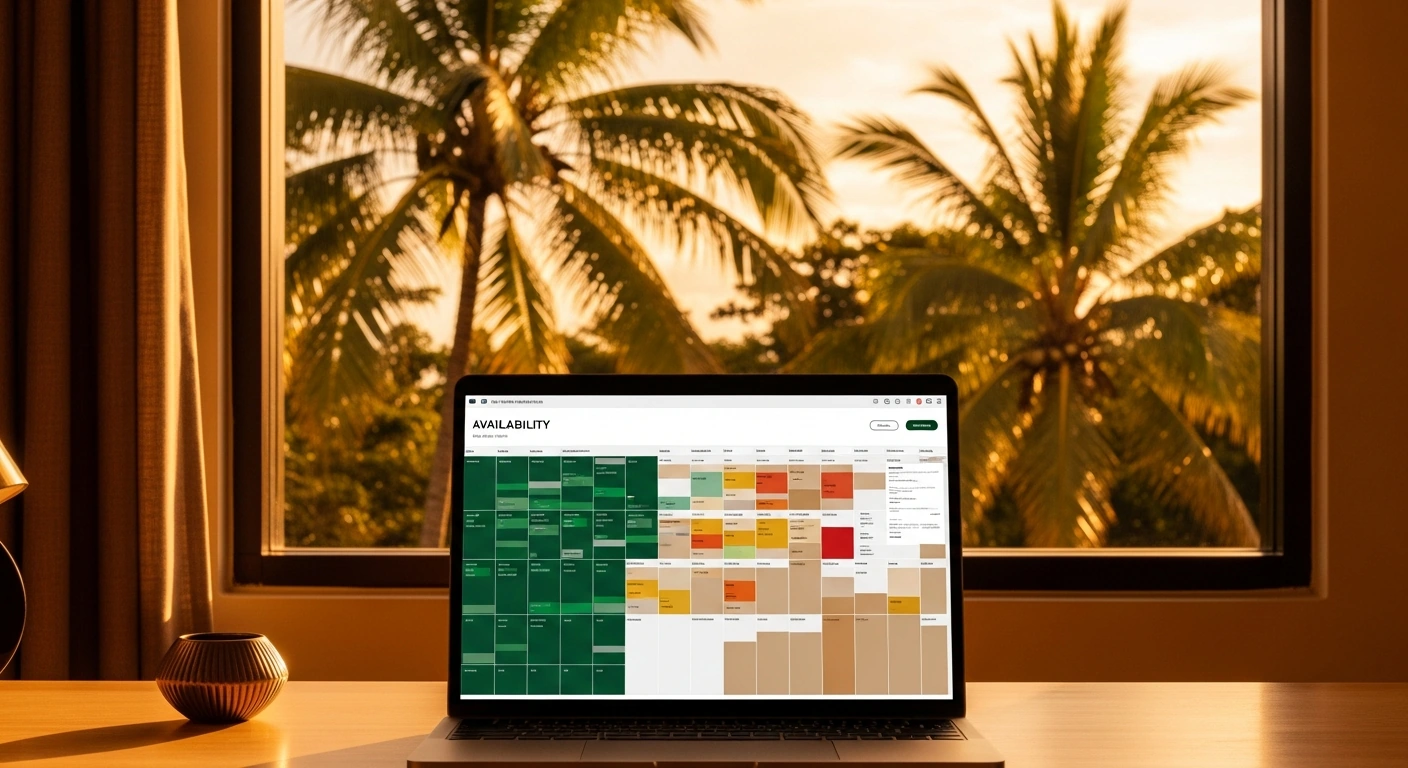
What the OTA trap actually looks like
The trap is not using OTAs. The trap is building a hotel business where OTAs are the only thing keeping the calendar full. When 70, 80, or 90% of your bookings come through Booking.com and Expedia, you have handed those companies control over your revenue in exchange for their traffic. When they change their algorithm, adjust their commission structure, or a new competitor outranks you, your business feels it immediately.
More concretely, the financial cost is significant. A 20% Booking.com commission on a $150/night room means $30 per booking goes to Booking.com. At 1,000 room nights per year, that is $30,000 in commissions. Reduce OTA dependency by 30% and you recover $9,000 annually without selling a single additional room night.
What OTA dependency actually costs your property
Why OTAs are still essential for independent hotels
Before getting into reduction strategies, it is worth being clear about why OTAs remain important. They provide access to travelers who would never find your property otherwise. They handle payment processing, cancellation management, and customer service for the bookings they originate. They provide social proof through a review system that many travelers trust more than a property's own website. And their marketing budgets dwarf anything an independent hotel can spend on search advertising.
The goal is not to exit OTAs. The goal is to stop being dependent on them while continuing to benefit from their reach. The difference matters: a dependent hotel panics when its Booking.com ranking drops. A strategically positioned hotel sees that drop, adjusts, and has enough direct booking volume to buffer the impact.
The four pillars of smart OTA strategy
1. Profile quality over quantity
Most independent hotels are on too many OTAs with mediocre profiles on all of them, rather than on fewer OTAs with excellent profiles. A complete, optimized Booking.com profile with professional photography, accurate room descriptions, full amenity lists, and a strong review response rate consistently outperforms an incomplete profile on five platforms. Audit every OTA profile you have and ask whether it presents your property as well as it deserves.
2. Review score management
Your OTA ranking is directly tied to your review score. A 0.5 point improvement on Booking.com's review scale can move you multiple positions in local search results, which compounds into significantly more bookings. This is one of the highest-ROI investments available to an independent hotel. A systematic approach to requesting and responding to reviews pays back many times over. Read our full guide on improving your hotel TripAdvisor and Google review score.
3. Commission cost analysis
Not all OTA commissions are equal. Booking.com's standard commission is typically 15 to 18%, while Expedia can run 20 to 25%. Some niche platforms charge less. Run a proper analysis of what each platform actually costs you per booking factoring in commission rate, average booking value, and the quality of guest it tends to send before deciding how much visibility to invest in each one.
4. Direct booking conversion
Every OTA guest is a potential future direct guest. The conversion happens through the quality of their stay experience, a well-timed direct booking incentive, and a post-stay email sequence that makes the value of booking direct clear. We cover this in depth in our guide on how to increase direct bookings without abandoning OTAs.
The 60-day OTA audit: The fastest way to start reducing commission dependency is to run a 60-day OTA audit. Review your booking data by channel, calculate the true cost per booking including commission and any marketing spend, identify which platforms are sending guests with the highest net value, and cut or deprioritize the ones with poor ROI. Most hotels find two or three platforms driving 90% of their OTA value.
What healthy OTA balance looks like
A well-positioned independent boutique hotel in Latin America typically aims for 35 to 50% of bookings from OTAs, 30 to 45% from direct channels, and the remainder from other sources like tour operators, travel agents, and corporate accounts. Getting there from 80% OTA dependency does not happen overnight it is typically an 18 to 24 month process of building the direct channel infrastructure while optimizing rather than abandoning OTA performance.
The properties that achieve this balance do not have smaller calendars. They have the same or better occupancy at significantly improved net revenue per room, because fewer of their bookings are subject to a 20% haircut before they hit the bank account.
Our OTA optimization service covers the full audit, profile rebuild, and commission reduction strategy. If you want to see how this plays out in practice, the Puntarenas case study shows a property that reduced OTA commission share from 78% to 50% within eight months while growing total revenue.
Keep reading
Frequently asked questions
There is no universal right answer, but most revenue management professionals consider 40 to 60% OTA dependency to be a healthy range for independent boutique hotels. Below 40% suggests strong direct booking performance. Above 70% means OTAs have too much control over your revenue and you are likely paying $10,000 or more per year in avoidable commissions.
Being on the right OTAs helps. Being on every OTA without a strategy creates rate management complexity, increases overbooking risk, and dilutes your focus. The goal is to identify which 3 to 5 platforms drive the most qualified bookings for your specific property and guest profile, then optimize those rather than spreading thin across every available platform.
Rate parity clauses in many OTA contracts technically require you to match rates across channels. However, there are compliant ways to incentivize direct bookings added value (free breakfast, late checkout, room upgrades), member rates accessed after a simple email signup, or exclusive packages not available on OTAs. Always review your specific OTA contract terms and consult a specialist before adjusting rates.
Booking.com ranking has a direct and significant impact on visibility and bookings. Properties on page one of their market generate dramatically more bookings than those on page two or three. Ranking is influenced by review score, profile completeness, content quality, response rate, commission level, and booking conversion rate. A structured OTA optimization program can improve ranking position within 60 to 90 days.
The most effective conversion point is during the stay, not after. A warm interaction at check-in, a simple in-room card explaining the benefits of booking direct, and a post-stay email with a direct booking incentive are the three highest-impact touchpoints. The goal is to make the guest feel a personal connection to your property rather than a transaction through a third-party platform.
Find out exactly what OTA dependency is costing your property
We audit your OTA presence, calculate your true commission cost, and show you a clear path to reducing dependency without losing occupancy. Free. No obligation.
Book your free Revenue Audit✓ No commitment ✓ 30-minute call ✓ Real insights, guaranteed